There's a reason Dubai desert safaris feel like stepping into a different era. The "Arabian Nights" atmosphere at our desert camps isn't accidental -- our team spends hours each day getting the lighting, food prep, and show schedule right. Here's what actually creates that feeling, and how to get the most from your evening.
The sunset: when the desert changes completely
Everything starts at dusk. Around 5:30-6:30 PM (depending on season), the desert shifts in ways that catch first-timers off guard:
- The sand changes colour -- from harsh yellow to warm gold, then deep orange in about 20 minutes
- Temperature drops 10-15°C within an hour of sunset. If you're in shorts, you'll notice
- Wind dies down completely. The silence is genuinely unsettling if you're used to city noise
- Photographers call it "golden hour" and there's a reason -- the light at this point makes everyone look good
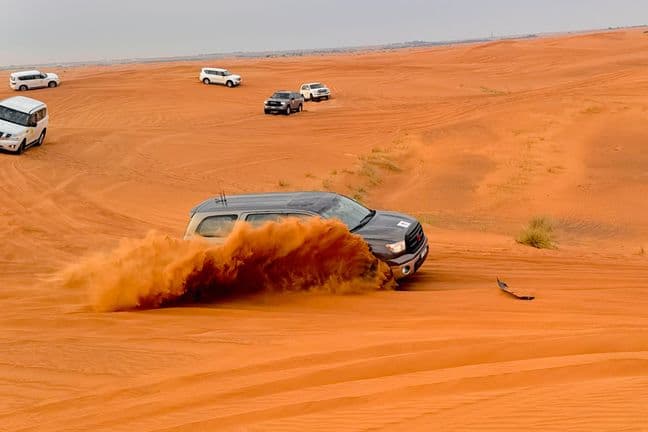
This is when we pause for photos. Our drivers calculate sunset to the minute each day and adjust the route so we're at the highest dune at exactly the right moment. More on how that works in our behind-the-scenes look at safari planning.
The Bedouin camp: what makes it feel real
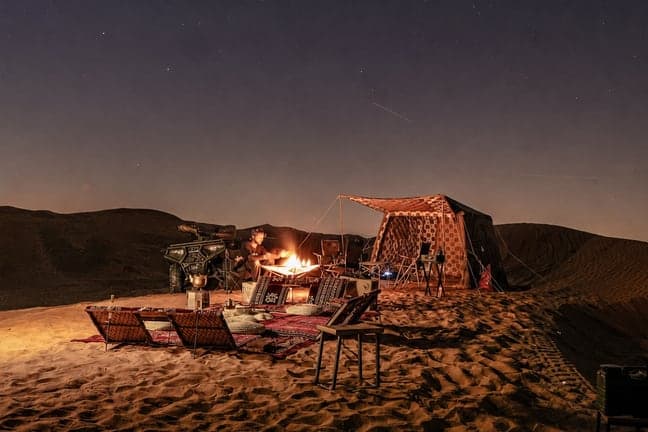
After sunset, you arrive at camp. These are purpose-built for tourists -- we're honest about that -- but the design pulls from actual Bedouin settlements, and you can feel the difference from a hotel banquet hall.
How the camp is set up
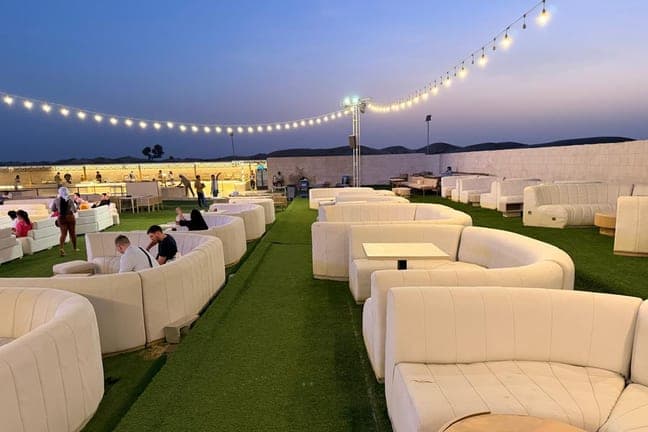
- Low cushions and carpets on the sand, not chairs at tables. Your shoes come off
- LED lanterns styled to look like traditional oil lamps. The flicker is artificial but the warmth isn't
- Canvas and bamboo canopies overhead, open sides. You're outside, not in a building
- Sand floor under everything. You'll be brushing sand off your clothes the next morning
Cultural details that set the mood
- Arabic coffee (gahwa) served in small cups, lightly spiced with cardamom. It's stronger than you'd expect
- Dates offered the moment you arrive -- this is traditional Arabian hospitality, not just a snack
- Oud and bakhoor incense burning throughout the camp. The smell sticks to your clothes
- Shisha stations with flavoured tobacco. Even non-smokers tend to try it once
What to wear for the evening desert safari
We get asked about clothing more than almost anything else, and the answer isn't as obvious as you'd think. The desert looks hot in photos, but evenings tell a different story.
The temperature trap
Most guests show up in shorts and sandals because they've been walking around Dubai Marina at 38°C all day. Then sunset hits and the temperature drops fast -- sometimes to 18-20°C in winter months (December through February). By 9 PM, you'll wish you'd brought a layer.
What works well
- Light trousers or jeans over shorts. You're sitting on carpets on sand, and bare legs get cold once the sun's gone
- A light jacket or hoodie you can tie around your waist during dune bashing and pull on at camp. November to March, this isn't optional
- Closed-toe shoes or sturdy sandals. Flip-flops fill with sand within 30 seconds of stepping out of the vehicle. Trainers work fine -- they'll get sandy but they'll survive
- A scarf or shawl for women who want to cover shoulders during the cooler part of the evening. Also useful as a makeshift blanket
What to skip
- High heels or dress shoes. You're walking on sand. We've seen guests try it and it doesn't end well
- Anything white if you care about stains. The sand gets everywhere, and the BBQ smoke drifts
- Heavy coats. Even in January, a light layer is enough. You won't need a parka
If you're visiting during summer (June through August), you can get away with lighter clothing since nighttime temperatures stay around 30°C. But the rest of the year, layering is the move. We've covered seasonal packing in more detail in our what to wear on a desert safari guide.
Live shows at the desert camp: Tanoura, belly dance, and fire
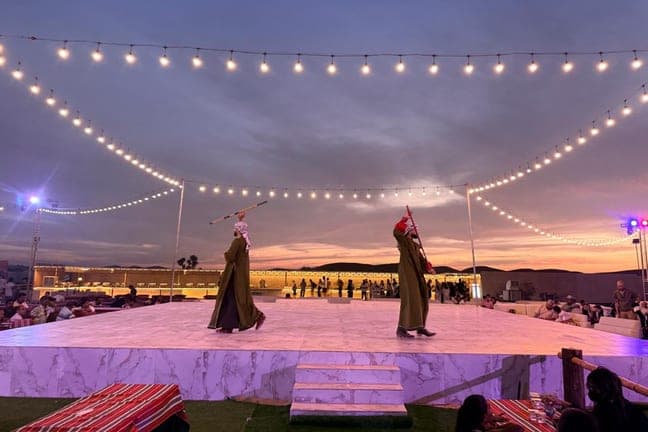
The performances are where people usually put their phones down and just watch. These aren't stage shows with special effects -- they're cultural traditions that have been around for centuries, performed by artists who train for years.

Tanoura dance
The Tanoura is the one everyone remembers. A single dancer in a heavy, colourful skirt spins continuously for 10-15 minutes without stopping. It comes from Sufi spiritual practice -- the spinning is supposed to bring the dancer closer to a meditative state. Under camp lights, the skirt creates patterns and colour trails that are genuinely hard to look away from. Our Tanoura performers have trained for 3-5 years before performing at camps. For more on the full show schedule, see our desert safari entertainment guide.
Belly dance
Belly dancing has deep roots in Middle Eastern culture, though it's often reduced to "entertainment" for tourists. The traditional version focuses on isolation movements of the torso and hips. At our camps, the performance runs about 10-15 minutes during dinner, and the dancer usually invites a few guests to try basic moves. It gets awkward in the best way.
Fire show
The fire show closes the evening at most camps:
- Fire poi -- spinning chains with lit ends that create arcs of flame in the dark
- Brief fire breathing for dramatic effect
- Fire eating -- the performer puts out flames in their mouth
Performers stay a safe distance from the audience. The flames against a pitch-black desert background make for great photos if you turn your flash off.

BBQ dinner under the desert sky
Dinner at camp is set up as a communal feast, not a restaurant service. That's deliberate -- it's how traditional Arabian gatherings work.
What's on the buffet
- Grilled lamb, chicken, and beef prepared on open flames right at the camp
- Arabic salads: fattoush, tabbouleh, hummus, baba ganoush
- Rice dishes including biryani and saffron rice
- Fresh Arabic flatbread baked on site
- Baklava, dates, and assorted Arabic sweets for dessert
We've written a full menu breakdown with vegetarian options in our desert safari BBQ dinner guide.
The atmosphere during dinner
You eat at shared low tables on carpets. Traditional Arabic instruments play in the background -- oud and tabla, mostly. There's no roof above you, just sky. By 8:30 PM in winter, you can already see stars coming out while you eat.
Stargazing: the part most people don't expect
Here's something tourists regularly tell us they didn't anticipate: the desert sky. Our camps are far enough from Dubai's light pollution that stars are properly visible, and on clear nights, it's stunning.
What you can actually see
- The Milky Way on clear, moonless nights (yes, really)
- Orion and Scorpius clearly defined -- you don't need a guide to spot them
- Shooting stars more often than you'd think
- Satellites crossing the sky as slow-moving points of light
Best conditions for stargazing
- New moon nights give you the darkest sky
- November through March: clearer air, less humidity
- After 9 PM, once camp lights dim following the shows
If you're visiting during the right months, check our best time to visit guide for moon phase timing.
How to photograph the desert at night
We see a lot of guests get frustrated with their photos at camp. The shows look incredible in person, but phone cameras struggle in low light. Here's what we've learned from watching thousands of people try.
Phone camera tips that actually work
- Turn off your flash. This is the single biggest improvement you can make. Flash washes out the warm lantern lighting and kills the atmosphere in every shot. The Tanoura skirt colours disappear completely with flash on
- Use night mode if your phone has it (most phones from 2020 onward do). Hold still for 2-3 seconds while it processes. The results are surprisingly good
- Prop your phone against something -- a water bottle, your shoe, a cushion -- to keep it steady during longer exposures. Shaky hands are the main reason night photos come out blurry
- Shoot during the fire show. Fire gives off enough light that even basic phone cameras can capture decent shots. The contrast between flames and dark sky works well without any editing
For people with actual cameras
If you've brought a DSLR or mirrorless camera, the desert at night is genuinely rewarding to shoot:
- Starscape settings: ISO 1600-3200, f/2.8 or wider, 15-25 second exposure. A small tripod fits in a daypack and makes a huge difference
- Camp portraits: ISO 800-1600, f/2.8, 1/60 second. The lantern light gives a warm, natural look that doesn't need much post-processing
- Fire show: ISO 400-800, f/4, 1/250 second to freeze the flame trails. Burst mode helps catch the best moments
- Tanoura dance: Try a slower shutter speed (1/15 to 1/30) to capture the motion blur of the spinning skirt. It creates those light-trail effects you see in professional shots
Timing your shots
The best photo opportunities happen at specific moments during the evening:
- Sunset (5:30-6:30 PM): Best for landscape and group shots. The light does all the work
- First arrival at camp (6:30-7:00 PM): Lanterns are lit but there's still some blue in the sky. This "blue hour" window lasts about 15 minutes and it's the sweet spot for camp photos
- Fire show (8:00-8:30 PM): Most dramatic shots of the night
- After shows end (9:00 PM onward): Camp clears out, lights dim, and you get the desert sky to yourself
How to get the most out of your evening
After running these safaris for years, here's what we tell guests who want the full atmosphere:
Worth doing
- Put your phone away during the Tanoura, at least. Watch it with your eyes -- the patterns are better in person than on a screen
- Try the shisha, even one puff. It's part of the experience
- Sit on the carpets instead of at tables. Ground seating feels completely different
- Don't rush to leave after the shows end. The quiet desert at 9:30 PM, after most guests have gone, is genuinely special
- Try on the traditional costumes for photos -- they're available at every camp and most people get a kick out of it
Don't bother with
- Recording every single performance. You won't rewatch 15 minutes of shaky Tanoura footage
- Rushing to the bus the second entertainment wraps up. The drive back doesn't leave without you
- Expecting a Cirque du Soleil production. This is more authentic than theatrical, and that's the point
Which desert safari packages include the full show lineup?
Not every package comes with the complete evening entertainment. Here's what you get with each:
| Package | Entertainment | Good for |
|---|---|---|
| Desert Safari Dubai | Tanoura, belly dance, fire show, BBQ dinner | First-timers who want everything |
| Premium Desert Safari | Same shows plus VIP seating closer to the stage | Better views of performances, less crowded |
| Desert Safari + Quad Bike | Full shows plus 30 min quad biking before sunset | People who want adventure and atmosphere |
If the Arabian Nights atmosphere matters to you, book an evening safari. Morning safaris focus on adventure (dune bashing, sandboarding) but skip the camp shows and BBQ dinner entirely.
Honest take: is it real or manufactured?
Both, honestly. These are tourist camps, not actual Bedouin villages. The performances are rehearsed, the food is catered by a kitchen team that starts prep at noon, and you're sharing the experience with 40-80 other guests depending on the night.
But the desert sunset is real. The stars are real. The Tanoura dancer trained for years. The Arabic coffee recipe hasn't changed in centuries. The "Arabian Nights" feeling works because it's built on actual cultural traditions, even if the packaging is designed for visitors. We've never had a guest tell us it felt fake.
If you want to add a deeper cultural element to your trip, the Abu Dhabi City Tour includes the Sheikh Zayed Grand Mosque, which is worth seeing regardless of your background. And our cultural experiences guide covers the morning safari option for a quieter, more intimate Bedouin experience.
Still deciding between packages? Our safari comparison guide lays out all the options side by side.
Frequently asked questions about Arabian Nights desert safaris
How long does the evening desert safari last?
The full evening runs about 6 hours, usually from around 3:30 PM pickup to 9:30-10:00 PM drop-off. Dune bashing and the sunset stop take up the first 90 minutes or so. Then you're at camp from roughly 6:00 PM until the end. Some guests leave right after the fire show wraps up around 8:30 PM, but we'd recommend staying until at least 9:00 PM -- that's when the camp quiets down and you get the best stargazing — or stay overnight at a desert camp and have the sky to yourself.
Is the Arabian Nights safari suitable for kids?
Yes, and families make up a good portion of our evening guests. Kids under 3 ride free, and children 3-11 get reduced rates on most packages. The Tanoura dance is usually a hit with kids -- they're mesmerized by the spinning colours. A few things to know: the dune bashing can be intense for very young children (under 5), so let your driver know if you'd prefer a gentler ride. Also, the shows run until about 8:30 PM, so younger kids sometimes get tired toward the end. Bringing a light blanket for them to nap on the carpets isn't a bad idea.
Can I book just the camp dinner and shows without dune bashing?
We don't offer a camp-only option as a separate booking, but if you'd prefer to skip the dune bashing, just let your driver know when they pick you up. They'll take a gentler route to camp instead of the full off-road experience. You'll still arrive at the same time as everyone else and get the complete camp experience -- dinner, shows, stargazing, the lot. Check our Desert Safari Dubai package for the full evening itinerary.
What happens if the weather is bad?
Rain in the Dubai desert is rare -- we're talking maybe 5-10 days a year -- but it does happen, mostly between December and February. If there's light rain, safaris usually go ahead. The camp has partial canopy cover over the dining and performance areas, so you won't be sitting in the open. If there's a sandstorm or heavy rain, we'll reschedule your booking to another date at no charge. We monitor weather conditions from about 2 PM on safari days and contact guests by phone if there's any change to the plan.