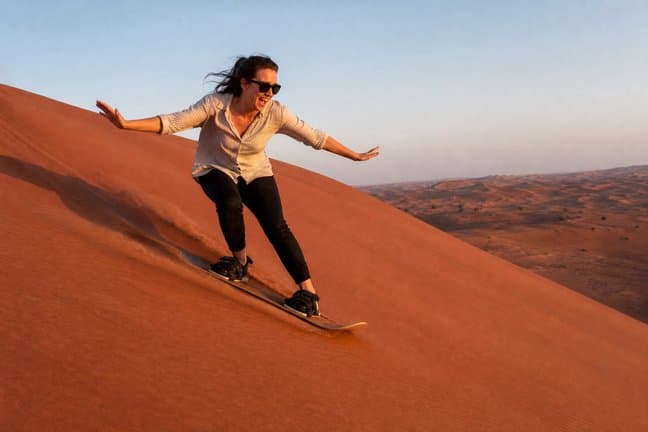
Sandboarding in Dubai is one of those activities that sounds harder than it actually is. You stand on a board, point it downhill, and gravity does most of the work. There's no lift pass, no ice, and no trees to dodge -- just a steep wall of red sand and a surprisingly soft landing at the bottom. We've watched thousands of first-timers try it over the years, and most people are riding within five minutes.
If you're looking into sandboarding Dubai as a standalone activity, here's what you should actually know -- where it happens, what it costs, how the technique works, and what to expect on the day.
What Is Sandboarding in Dubai?
Sandboarding is exactly what it sounds like: snowboarding, but on sand dunes instead of snow. You strap your feet onto a board (or in some setups, you sit and ride it toboggan-style), walk up to the top of a dune, and slide down. The board is waxed on the underside so it glides across the sand surface.
There are two main styles you'll encounter in the Dubai desert:
- Stand-up sandboarding -- feet strapped to bindings, body sideways, carving turns on the way down. This is closer to actual snowboarding. It takes a few runs to get the hang of it, and you will fall. Everyone falls.
- Sand tobogganing (sit-down) -- you sit on the board and ride it like a sled. No balance required. This is what most families with kids end up doing, and honestly, it's just as fun. Maybe more fun, because you can go full speed without worrying about catching an edge.
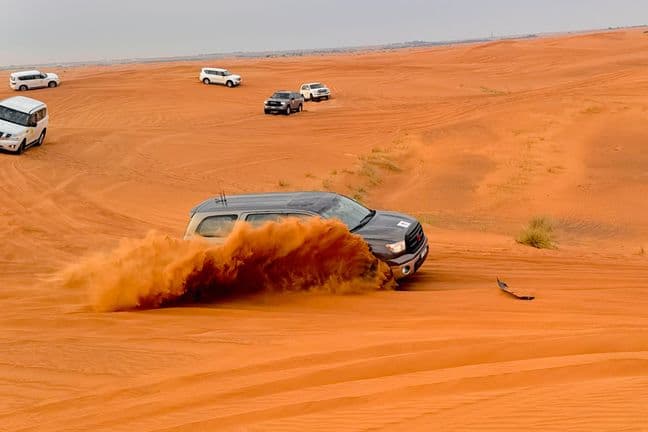
Most desert safari packages in Dubai include sandboarding as a standard activity. It's part of the dune stop -- you'll usually get 20 to 30 minutes on the dunes between the 4x4 drive and the camp activities.
Where Does Sandboarding Take Place?
Dubai sandboarding happens at the Lahbab desert area, also called the "Red Dunes" or Al Lahbab. It's about 45 minutes from Downtown Dubai, depending on traffic on the E44 (Dubai-Hatta highway). The area sits near the Oman border, southeast of the city.
Why Lahbab specifically? Three reasons:
- Dune height. The red dunes here reach 30 to 50 metres high in some spots. That's steep enough for a proper ride but not so extreme that beginners panic.
- Sand type. The iron oxide in the sand gives it that distinctive reddish-orange colour. More importantly, the grain size creates good surface friction -- you slide, but you don't fly out of control.
- Accessibility. Lahbab is a designated off-road area managed by Dubai Municipality. Tour operators have permits to use specific dune zones, which keeps the experience organised and safe.
Some operators in the northern emirates use the Sharjah desert or Ras Al Khaimah dunes, but the vast majority of sandboarding in the Dubai desert happens at Lahbab. It's where our team operates every day, and the dune conditions there are consistently good year-round.
Getting There
You don't need to figure out directions. Every desert safari booking includes hotel pickup from anywhere in Dubai -- Downtown, Marina, JBR, Deira, Business Bay, you name it. Our drivers pick you up in a Land Cruiser and handle the drive out. You'll pass the Last Exit food truck stop on the highway, which is a useful landmark to know you're about 15 minutes away.
How to Sandboard: Technique for Beginners
Here's the honest truth: sandboarding is much easier than snowboarding. The sand is slower, the falls are softer, and the runs are shorter. You're not going to pick up dangerous speed.
That said, a bit of technique makes the difference between a smooth run and an awkward tumble.
Stand-Up Sandboarding Steps
- Start at the top of the dune. Our guides will point you to the right slope -- not too steep for your first go. Strap both feet in. Keep your knees bent. Don't stand stiff like a plank; that's how people fall backwards.
- Face sideways. Your dominant foot goes in the back (right foot back if you're right-handed, usually). Look downhill, not at your feet.
- Lean forward slightly. This is the one thing people get wrong. They lean back because they're nervous, and that sends the board out from under them. Lean into it. Weight on your front foot to start moving.
- Shift weight to control speed. Press your toes down (heelside edge) to slow down. Press your heels (toeside edge) to speed up and carve. On sand, the response is slower than snow, so you have more time to react.
- Sit down to stop. Seriously. If things feel fast, just sit. The sand will stop you within a metre. No shame in it.
Sit-Down Toboggan Style
Sit on the board, feet in front of you, lean back slightly, and push off. Drag your hands in the sand to steer. That's it. Kids as young as 4 or 5 do this with our team, and they love it.
One tip: close your mouth on the way down. Sand gets everywhere regardless, but there's no reason to help it along.
Sandboarding Dubai Price: Is It Included or Extra?
This is the question we get asked most, so let's be clear: sandboarding is included in every desert safari package we offer at no extra cost. You don't pay separately for it. It's part of the standard dune activities alongside dune bashing and photo stops.
That applies to:
- Desert Safari Dubai -- our most popular package, includes sandboarding during the dune stop
- Premium Desert Safari Dubai -- same sandboarding, plus additional activities and a more exclusive camp setup
- Morning desert safaris -- sandboarding happens in the cooler morning hours, which is actually better for the activity since the sand isn't scorching hot
The boards are provided by us. You don't need to bring anything. We carry multiple boards in the vehicles -- different sizes for adults and kids.
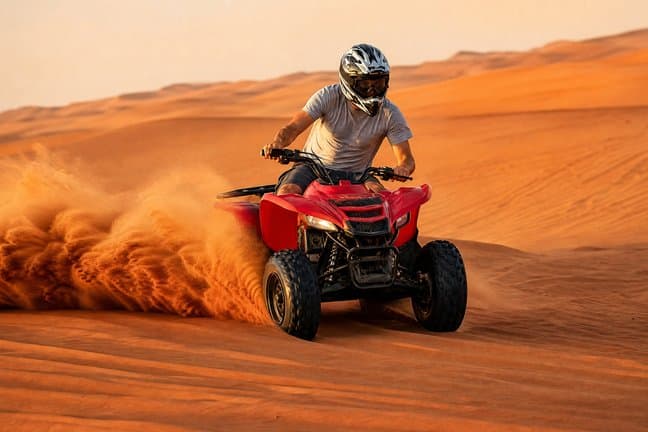
If you want sandboarding bundled with motorised dune sports, the desert safari with quad bike package adds a self-drive quad ride on the same dunes, and our standalone Dubai quad bike tour runs from the same Lahbab area. Both still include sandboarding at no extra charge.
Now, you might see some tour listings advertising "sandboarding experience" as a standalone activity priced at 200-400 AED. In most cases, that's just a shortened safari package marketed differently. There aren't really standalone sandboarding-only operations in Dubai the way there are ski resorts for snowboarding. The logistics of getting to Lahbab, having equipment, and having guides on the dunes means it's always bundled into a safari.
So when you're comparing sandboarding Dubai prices, you're really comparing desert safari prices. And since ours include sandboarding as standard, you're getting it at no additional charge.
Best Time for Sandboarding in Dubai
The ideal months are October through April, when daytime temperatures sit between 22-32 degrees Celsius. The sand is warm but not burning, the wind is manageable, and you won't be drenched in sweat after one run up the dune.
But sandboarding works in summer too -- with caveats.
Summer Sandboarding (May-September)
Sand surface temperatures can hit 60-70 degrees Celsius in the afternoon during July and August. That's not sandboarding weather. However, morning safaris that start at 7am or 8am dodge the worst of it. The sand hasn't had time to heat up yet, and the air temperature is more like 35-38 degrees -- still hot, but manageable.
We've run summer morning sandboarding sessions where guests had a great time. The trick is finishing before 10am.
Wind Conditions
Here's something most guides won't mention: wind actually matters for sandboarding. Light wind (under 15 km/h) is ideal -- it keeps the sand surface firm and fast. Strong wind (the kind that kicks up sandstorms, usually February-March) makes the surface loose and slow, plus you'll eat a lot of sand. Our drivers monitor conditions daily and adjust the dune locations if needed.
Best Time of Day
Late afternoon (around 4pm-5pm) is the most popular for evening safaris. The light is golden, the temperatures are dropping, and the dunes look incredible for photos. Morning sessions (7am-9am) are quieter, cooler, and you'll often have the dunes more to yourself.
Sandboarding vs Snowboarding: Key Differences
If you've snowboarded before, you'll pick up sandboarding fast. But don't expect the same ride. Here's how they actually compare:
| Factor | Sandboarding | Snowboarding |
|---|---|---|
| Speed | Slower -- sand creates more friction. Top speed on a good dune is maybe 30-40 km/h | Much faster -- 60+ km/h easily on groomed runs |
| Falls | Soft landing every time. Sand absorbs impact. Worst case: sand in your clothes | Hard ice, packed snow, rocks. Falls can hurt |
| Turning | Wider, slower turns. The board digs in more | Sharp carving possible on hard snow |
| Getting back up | Walk up the dune. There's no chairlift. This is the workout part | Ski lifts do the heavy work |
| Equipment | Basic board with bindings, waxed underside. No boots required | Specialised board, bindings, boots, multiple layers of clothing |
| Learning curve | 30 minutes and you're riding | Usually takes a full day to link turns |
The biggest difference you'll feel is the drag. Sand doesn't glide the way snow does. You have to commit to steeper angles to maintain speed, and you can't really "cruise" the way you would on a blue run at a ski resort. Each run is more like a 15-30 second burst downhill, then the hike back up.
Honestly, the hike up is the hardest part. Climbing a sand dune in desert heat with a board under your arm builds leg muscles you didn't know you had. Most people do 4 to 6 runs before they're happy to move on to the next activity.
What to Wear for Sandboarding Dubai
This trips people up more than the actual boarding. Here's what works and what doesn't:
Wear
- Closed-toe shoes -- trainers or hiking shoes. The sand is hot, and you need ankle support for the board bindings. Flip-flops don't work. We've seen people try. It never goes well.
- Long lightweight trousers or leggings -- sand abrasion on bare legs during a fall is uncomfortable. Think thin joggers, not jeans (jeans get heavy with sand).
- A fitted T-shirt or long-sleeve sun shirt -- loose fabric catches wind and flaps around. Fitted is better.
- Sunglasses with a strap -- sand reflects harsh UV, and you'll want eye protection during falls.
- Sunscreen SPF 50 -- apply before you leave the hotel. The desert sun is no joke, even in winter months. Reapply after sweating.
Don't Wear
- Open-toed sandals -- hot sand burns and no grip in bindings
- Flowing dresses or abayas -- lovely for the camp dinner, terrible for dune sports
- Brand-new white clothes -- the red sand of Lahbab stains. It washes out eventually, but your fresh white trainers will be orange by the end
We provide the board and basic equipment. Just bring yourself, water (we have bottles in the vehicle), and a sense of humour about getting sandy. You will get sandy. Every pocket, every fold, everywhere. It's part of the deal.
Sandboarding Dubai Safety Tips
Sandboarding is one of the safer adventure activities in Dubai. In over 10 years of running safaris, we've had very few injuries from it -- mostly just scraped knees and bruised pride. But here are things to keep in mind:
- Listen to your guide's slope recommendation. Our team assesses the dune conditions daily. If they point you to a specific section, there's a reason. The steeper faces look tempting but can be tricky for beginners -- loose sand at the top, compacted at the bottom, which changes your speed suddenly.
- Stay hydrated. Climbing dunes in desert heat dehydrates you fast. Drink water between runs, not just when you feel thirsty. We keep chilled water in the vehicles for exactly this reason.
- Don't board head-first. Lying face-down on the board and going head-first down a dune is a recipe for a face full of sand at speed. Feet first if you're sitting, or standing up on the board. Those are the two safe options.
- Watch for other riders. Wait until the person ahead of you has cleared the bottom of the dune before you go. Sand sprays everywhere, and you can't steer well enough to avoid someone stopped in the landing zone.
- Know your limits. If you're tired, stop. The walk back up gets harder each time, and tired legs on a board lead to sloppy runs. Four or five good runs is a solid session.
- Children under 5 should toboggan only. Sit-down riding is fine for small kids. Stand-up boarding needs enough weight and leg strength to control the board, which most kids under 5 or 6 don't have yet.
People with knee problems or back issues should take it easy on the dune climbing -- that's actually more demanding than the boarding itself. There's no rule saying you have to walk to the very top. A shorter run from halfway up the dune is still good fun and saves your joints.
Frequently Asked Questions
Is sandboarding in Dubai safe for kids?
Yes. Sit-down sandboarding (toboggan style) is safe for children as young as 4 or 5. The sand is soft, speeds are low, and our guides supervise every run. For stand-up boarding, we generally recommend age 8 and up, depending on the child's confidence and coordination.
Do I need prior snowboarding or surfing experience?
Not at all. Most of our guests have never stood on any kind of board before. The learning curve is short -- sandboarding is much slower and more forgiving than snowboarding. Our guides walk you through the basics in about five minutes, and you're off. If you do have board experience, you'll find it easy to pick up.
What's included in the sandboarding Dubai price?
Sandboarding is included free with every desert safari package we offer. That covers the board, the guide, the dune access, and hotel pickup and drop-off. There's no separate fee. Check our desert safari packages for full pricing that includes sandboarding along with dune bashing, camel riding, BBQ dinner, and entertainment shows.
Can I go sandboarding in Dubai during summer?
You can, but only on morning safaris. Afternoon sand temperatures in July and August reach 60-70 degrees Celsius, which makes it impractical and uncomfortable. Morning departures (7am-8am) avoid the worst heat. October through April is the ideal window for sandboarding at any time of day.
How long does the sandboarding session last?
Typically 20 to 30 minutes during the dune stop of your safari. That's enough time for 4 to 6 runs, depending on dune height and how fast you climb back up. It's part of the broader dune activities that also include dune bashing and photo stops, so the total time on the dunes is about 45 minutes to an hour.
Can I combine sandboarding with quad biking in Dubai?
Yes. Several of our safaris pair both on the same trip. The desert safari with quad bike gives you a self-drive quad ride plus sandboarding, dune bashing, and the camp dinner. If you mainly want the quad, the Dubai quad bike tour still includes a sandboarding stop. Both run on the Lahbab red dunes.