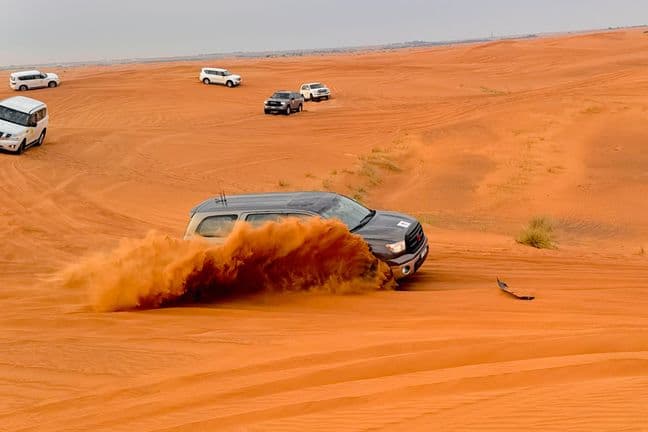
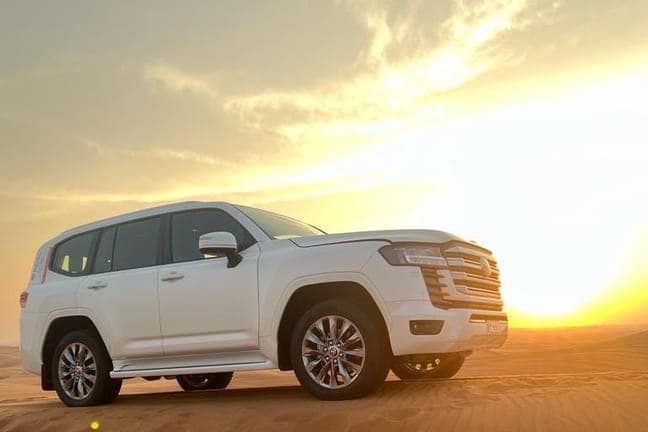
Most people book a "desert safari" and assume all Dubai desert looks the same. It doesn't. The Lahbab Desert, about 45 minutes southeast of Downtown, has sand that's genuinely red -- not golden, not beige, but a rust-colored orange that photographs completely differently from the Al Awir area where most budget safaris go.
I've driven guests to both locations hundreds of times, and the reaction at Lahbab is always the same: "Wait, why is this sand red?" So let's start there.
Why is the sand red at Lahbab?
The short answer: iron oxide. The same chemical process that turns metal rusty turns sand red.
Here's the longer version. The sand grains at Lahbab are mostly quartz -- same as any desert. But over millions of years, iron-rich rocks in the region eroded and the iron particles mixed with the quartz. Exposure to oxygen in the dry desert air oxidized the iron, creating a thin coating of iron oxide (Fe2O3) on each grain. It's the exact same compound as rust on a nail, just spread across billions of sand particles.
The Arabian Desert's geology shows that these sands are 80-90% quartz with the remainder being feldspar. The iron oxide coating is what creates the color variation you see across the UAE -- from pale golden near Dubai's coast to deep red-orange inland at Lahbab and the Al Madam region near the Oman border.
Two things control how red the sand looks on any given day:
- Sun angle. At sunrise (around 6:00-6:45 AM) and golden hour (5:00-6:30 PM), low-angle light makes the iron oxide glow. The sand looks genuinely crimson. At midday, that same sand appears washed-out pale orange -- barely worth photographing.
- Moisture. After rare rain (maybe 5-10 times a year), the wet sand turns a deep burgundy for a few hours. If you happen to be there after a rainfall, the photos are extraordinary.
Where exactly are the red sand dunes?
The main red dune area is the Lahbab Desert (also spelled Al Lahbab, sometimes called Al-Faya). It's about 50-60 kilometers southeast of Downtown Dubai, off the Dubai-Al Ain Road (E66). The drive takes 45-55 minutes depending on traffic.
Here's how Lahbab compares to the other safari locations around Dubai:
| Location | Drive from Downtown | Sand color | Dune height | Crowd level |
|---|---|---|---|---|
| Lahbab (red dunes) | 45-55 min | Red-orange | 80-100 meters | Moderate |
| Al Awir | 30-40 min | Golden-beige | 20-50 meters | Very busy |
| Big Red (Highway 44) | 50-60 min | Red-orange | One large dune (~100m) | Busy on weekends |
| Dubai Desert Conservation Reserve | 40-50 min | Mixed gold/red | 30-60 meters | Low (permit only) |
Lahbab is the go-to for red dune safaris because it has continuous dune formations -- rolling ridges that stretch for kilometers, not just one isolated mound. That matters for dune bashing: the driver needs connected ridgelines to build a proper 30-45 minute route.
Big Red (Sharjah side of Highway 44) is popular with self-drivers and quad bikers but it's a single massive dune, not an area. You can't do a proper bashing circuit there.
Red dune safari vs regular desert safari: what actually changes
I see "difference between red dune safari and desert safari" in search queries constantly, and most answers online are vague. Here's what's genuinely different and what's marketing.
Things that are actually different
- The sand color (obviously). Your photos from Lahbab will have that red-orange contrast against blue sky that pops on Instagram. Regular desert at Al Awir gives you muted golden tones that can look washed out.
- Dune height and steepness. Lahbab dunes reach 80-100 meters. Al Awir dunes top out around 50 meters. Taller dunes mean steeper drops during dune bashing -- more intense, more screaming in the back seat.
- The drive is longer. Lahbab is 15-20 minutes further than Al Awir. Not a huge difference, but it means your pickup is earlier (typically 2:30-3:00 PM instead of 3:00-3:30 PM for evening safaris).
- Fewer vehicles. Al Awir gets congested during peak season because it's closer and cheaper for operators. Lahbab has fewer convoys, so the dunes feel less like a traffic jam.
Things that are the same
- Camp activities. BBQ dinner, belly dance, Tanoura, fire show, henna, shisha, camel rides -- all identical regardless of location. The camps themselves are interchangeable.
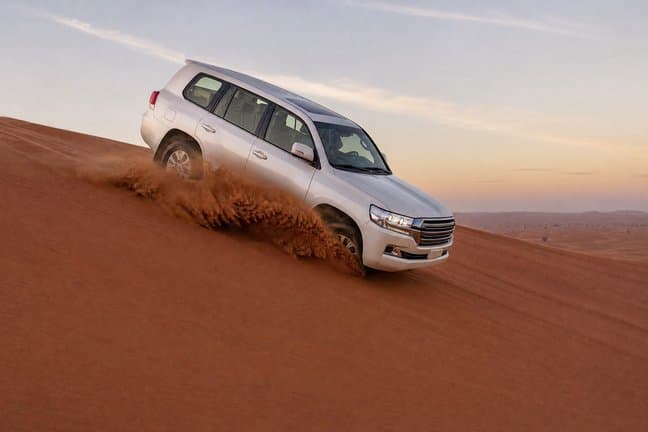
- Vehicle type. Same Toyota Land Cruisers at both locations. Lahbab doesn't magically get better cars.
- Sandboarding. The board is the same. The main difference is the steeper Lahbab slopes give you faster runs.
For a deep dive into the dune bashing experience specifically, check out our guide to what red dune bashing is actually like -- it covers motion sickness tips, intensity levels, and who should skip it.
What happens during a red dune evening safari
Most people book the evening option. Here's how the timing works -- we've run this route thousands of times so these times are accurate for November through March (summer schedules shift about an hour).
2:30 - 3:30 PM: hotel pickup
A shared Land Cruiser collects you from your hotel lobby. You'll share with 5-6 other guests. The driver handles all the driving -- you just sit back. If you're at a hotel in Dubai Marina or JBR, you'll be among the first pickups. Downtown hotels are usually last.
3:30 - 4:30 PM: the drive to Lahbab
The route goes through Dubai's outskirts past the Last Exit food truck stops. Once you're off the highway and into the desert, all the vehicles from your tour group gather at a meeting point. Drivers deflate tires to about 15 PSI for sand traction, check in with each other by radio, and enter the dunes together in convoy.
4:30 - 5:30 PM: dune bashing
This is the part everyone talks about. The driver pushes the Land Cruiser over the dune crests and slides down the far side at angles that feel impossible. Steepest drops are around 50-60 degrees. The whole ride lasts 30-45 minutes depending on the operator and package.
Practical note: if you get carsick, ask for the front seat and tell the driver you want a gentler ride. They can adjust the intensity. More on this in our Lahbab dune bashing safety guide.
5:30 - 6:00 PM: photo stop and sandboarding
At the highest dune, the convoy stops. This is your golden-hour window. The red sand against the low sun is genuinely photogenic -- I still take photos here myself and I've seen it hundreds of times. Sandboarding is available on the slope; most people get 3-4 runs before it's time to move on.
6:00 - 9:00 PM: desert camp
The camp runs like a set schedule:
- Arrival: welcome drinks (Arabic coffee, dates, water)
- Camel rides: 15-20 minute loop around the camp (more details in our camel riding first-timer's guide)
- Henna painting station (free, takes about 10-15 minutes)
- Traditional costume photo area
- Shisha lounge
- BBQ dinner buffet starts around 7:30 PM -- grilled lamb, chicken, kebabs, hummus, biryani, salads, dessert (our BBQ dinner guide has the full menu breakdown)
- Entertainment from around 8:00 PM: belly dance (15 min), Tanoura spinning (15 min), fire show (10 min)
9:00 - 10:00 PM: return to hotel
Same route back. The drive takes 45-55 minutes. Most people fall asleep on the way -- it's a long day on your feet and the warm car knocks you out.
Best time of year for red dune safaris
Season matters more than you'd think for a desert trip:
| Season | Temperature at sunset | Crowds | What to expect |
|---|---|---|---|
| Nov - Feb (winter) | 20-25 degrees C | High -- peak season | Perfect weather, bring a light jacket for after sunset. Book 3+ days ahead. |
| Mar - Apr (spring) | 28-35 degrees C | Medium | Still comfortable, especially evenings. Good balance of price and availability. |
| May - Sep (summer) | 40-48 degrees C | Low | Brutal heat. Safaris still run but the camp has AC break areas. Lowest prices. |
| Oct (transition) | 32-38 degrees C | Medium | Hit or miss. Some October evenings are pleasant, others are still 38 degrees C at 5 PM. |
For more seasonal detail, check our month-by-month guide to desert safari timing.
What to wear to the red dunes
The red sand stains light-colored clothing more visibly than golden desert sand. A few practical tips:
- Best photo colors: white, black, or bright colors pop against the red backdrop. Beige or tan makes you invisible.
- Shoes: sandals you can shake sand out of, or closed shoes you're OK getting dusty. Not new white sneakers.
- For the camel ride: loose pants or long skirts work better than shorts. Getting on a camel in short shorts is awkward -- you're straddling a padded saddle 2 meters off the ground.
- After dark: temperatures drop 10-15 degrees C once the sun's down, especially in winter. A light jacket or hoodie is smart.
We wrote a full clothing guide: what to wear on a desert safari.
Red dune safari packages we run
We operate at Lahbab and offer two tiers:
| Package | What's different | Best for |
|---|---|---|
| Desert Safari Dubai -- Standard | Shared vehicle, group camp seating, 30 min dune bashing | First-timers, budget-conscious, families |
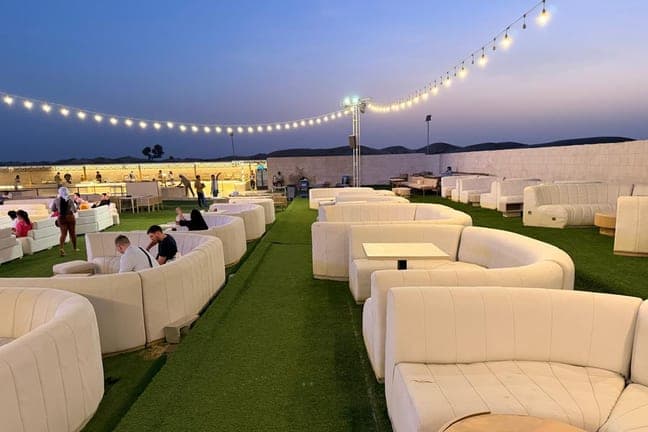
| Premium Desert Safari -- VIP | VIP sofa seating, longer bashing, priority service | Couples, special occasions, people who hate crowds |
Both go to the same red dunes at Lahbab. The real difference between standard and premium is the camp experience, not the location. Our standard vs premium comparison breaks down exactly what changes at each tier.
If you'd rather drive yourself, our 2-seater dune buggy and 4-seater dune buggy tours also operate on the red dunes, though on a separate route from the Land Cruiser safaris.
The honest take
Is a red dune safari worth the extra 15-20 minutes of drive time? For most people, yes. The photos are noticeably better, the dunes are taller, and the area's less congested than Al Awir.
The one case where I'd say save the money: if you're booking a budget safari specifically because price matters most, and the operator offers the same activities at Al Awir for less. The camp entertainment is identical either way. You're paying the premium for scenery and dune height, not for different activities.
Not sure which package fits? Our safari comparison guide walks you through the options based on group size, budget, and what you care about most.