Planning your first dune buggy ride in Dubai? It's completely normal to have safety questions -- and honestly, I'm glad you're asking them. After guiding hundreds of first-time riders through the desert over the past few years, I've learned that the people who look up safety info beforehand almost always have a better time. They're not stressed. They know what to expect. And they don't make the rookie mistakes that turn a fun ride into a bad memory.
This guide covers what you actually need to know: age requirements, health considerations, what happens if a buggy tips over (and why the roll cage has you covered), what to wear, and how to tell a good operator from a sketchy one.
Is Dune Buggy Riding in Dubai Safe?
Short answer: yes, when you pick a licensed operator and follow the rules. Dubai's tourism authority (DET) regulates desert safari operators pretty strictly. They require:
- Regular vehicle safety inspections
- Certified guides with documented desert driving experience
- Comprehensive insurance coverage for all riders
- Mandatory safety equipment on every vehicle -- helmets, seatbelts, roll cages
- Emergency response protocols and first aid kits in the lead vehicle
That said, "safe" doesn't mean "zero risk." You're driving a powerful vehicle over shifting sand dunes. The terrain changes daily. Wind reshapes the dunes overnight, and what was a gentle slope yesterday could be a steep drop today. But that's exactly why you ride with a guide who knows the current conditions -- and why the safety briefing matters more than most people think.
Age and Health Requirements for Dune Buggy Dubai
Age Limits
Here's what most Dubai operators require:
- Drivers: minimum 16 years old — no driving license needed
- Passengers: minimum 6 years
- Maximum age: no hard limit, but you need to meet the health requirements below
For our 2-seater dune buggies, drivers need to be at least 16 — no driving license required. The 4-seater family buggies follow the same rule: driver 16+, passengers from age 6.
Health Considerations
Dune buggy riding puts real physical forces on your body -- sudden turns, bumps, and vibration for 30-60 minutes straight. You should skip this activity if you have:
- Back or neck problems (the jolts are no joke)
- Heart conditions
- Pregnancy at any stage
- Recent surgeries, especially abdominal or spinal
- Severe motion sickness (mild cases are usually fine with medication)
- Respiratory conditions affected by dust
If you're on the fence, talk to your doctor before booking. And don't worry about operators asking you health questions at check-in -- that's not bureaucracy. That's them doing their job properly. If an operator doesn't ask, that's actually a red flag.
What to Wear for a Dune Buggy Ride in Dubai
What you wear directly affects both your safety and how much you enjoy the ride. I've seen people show up in sandals and tank tops, and it never goes well. Here's what actually works:
Essential Clothing
- Closed-toe shoes: sneakers or boots with ankle support. No sandals, no exceptions. Sand fills open shoes in seconds
- Long pants: jeans, cargo pants, or hiking pants. They protect against sunburn, sand spray, and hot metal parts
- Long-sleeved shirt: light, breathable fabric in a light color. Your arms will thank you when the sand starts flying
- Bandana or neck gaiter: pull it over your nose and mouth during dusty sections. This is the item people are most grateful for
What the Operator Provides
- Helmet (mandatory, fitted to your head)
- Goggles or face shield
- Gloves (at better operators)
- Protective suit (for premium experiences)
For a full packing list including seasonal adjustments, check our guide on what to wear for Dubai desert safaris. And if you want the gear-specific checklist for buggy rides, our dune buggy gear checklist covers everything from sun protection to camera mounts.
Rollover Procedures: The Part Most Guides Skim Over
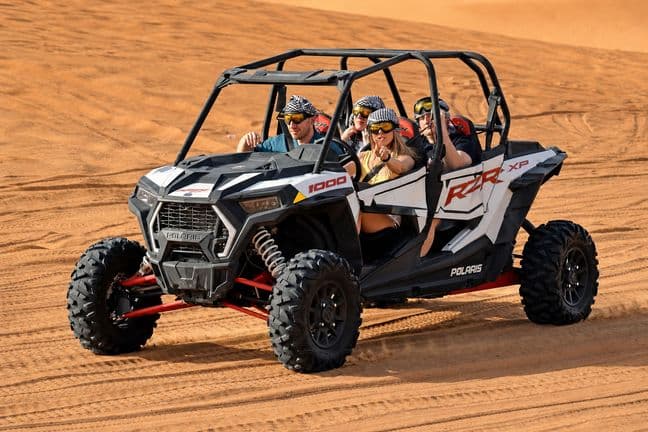
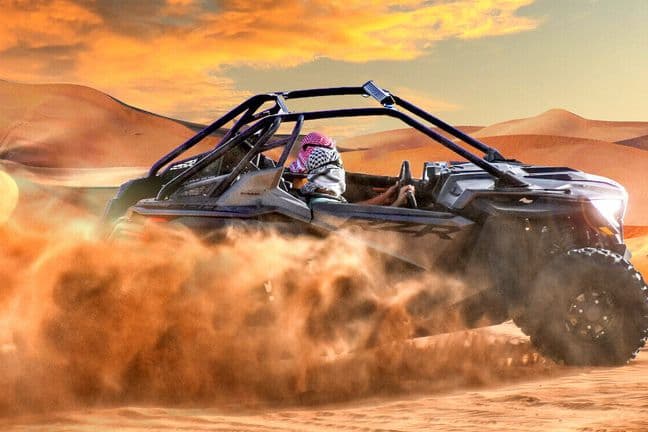
Nobody likes talking about rollovers, but this is the information that actually matters if something goes wrong. Modern dune buggies have full roll cages -- they're designed to protect you during a tip. The Polaris RZR buggies we use have been tested extensively for exactly this scenario.
If You Feel the Buggy Tipping
- DO NOT jump out. The roll cage protects you. The ground doesn't. Every serious injury I've heard about involved someone trying to bail out
- Keep both hands on the steering wheel or grab handles
- Tuck your chin to your chest -- protects your neck
- Keep arms and legs inside the vehicle
- Let the buggy complete the roll. Don't fight it
After a Rollover
- Stay calm and check yourself for injuries before moving
- Turn off the engine if you can reach the kill switch
- Wait for the guide to reach you before unbuckling
- Exit only when the vehicle is stable and the guide says it's clear
Quality operators cover this in their pre-ride safety briefing. If yours skips it, ask about rollover procedures before you start. That question alone tells you a lot about how seriously they take safety.
7 Safety Tips from Guides Who Do This Every Day
These come straight from our guides who see hundreds of riders each month. They're the mistakes they watch people make over and over:
1. Listen to the Full Safety Briefing
The whole thing. Not just the first two minutes while you're paying attention. Guides include specific info about today's conditions -- which dunes shifted overnight, where the soft sand is, what signals they'll use. It takes 10-15 minutes. It could prevent an accident.
2. Test Your Buggy Before You Leave the Staging Area
Before heading into the dunes:
- Test brakes at low speed -- get a feel for the stopping distance on sand
- Check steering response -- sand driving feels different from road driving
- Find the kill switch and make sure you can reach it
- Make sure the seatbelt clicks properly and holds firm
- Confirm your helmet fits snugly -- it shouldn't wobble
3. Keep Your Distance
Desert dust reduces visibility to near-zero in seconds. Keep at least 3-4 buggy lengths behind the vehicle ahead. If you can't see the buggy in front of you clearly, you're too close. I've seen rear-end bumps happen because someone closed the gap during a dust cloud.
4. Approach Dunes Straight On
Always approach dunes perpendicular to the ridge line -- straight up, straight down. Hitting a dune at an angle is the number one cause of rollovers. Your guide will demonstrate the proper technique on the first few dunes.
5. Control Your Speed on Descents
Going down is more dangerous than going up. Use engine braking (lower gear) rather than just stamping the brake pedal. Hard braking on a downhill slope causes the rear end to swing around, and that's how you lose control.
6. Stay Hydrated
Dehydration affects your reaction time and judgment -- both of which you need while driving. Drink water before your ride, during every break, and after. Most operators provide water, but bring an extra 500ml bottle. In summer, bring a full liter. Our guide on managing heat during desert safaris has more on this.
7. Learn the Hand Signals
Your guide communicates by hand when engines are too loud for shouting:
- Raised fist: stop immediately
- Waving arm: follow me
- Pointing down: slow down
- Crossed arms: danger ahead, full stop
How to Pick a Safe Dune Buggy Operator in Dubai
Not all operators take safety equally seriously. After years in this industry, here's how to tell the good ones from the ones cutting corners:
Green Flags
- DET licensed and insured (ask to see the license -- legit operators don't mind)
- Detailed safety briefing before departure -- 10+ minutes, not a quick two-sentence rundown
- Well-maintained vehicles (check Google reviews for complaints about equipment)
- Guide-to-rider ratio of 1:4 or better
- Provides all safety equipment -- helmets, goggles, seatbelts
- Asks about your health conditions and experience level at check-in
- Has clearly posted safety policies on their website or at the meeting point
Red Flags
- No safety briefing, or a rushed 30-second version
- Worn or cracked helmets -- if the foam inside is compressed or the shell has cracks, walk away
- Vehicles with visible damage, bald tires, or maintenance issues
- Guides who seem rushed, distracted, or uninterested in your questions
- No questions about health or experience -- they should be asking YOU, not the other way around
- Pressure to book immediately without giving you full safety information
Our 2-seater and 4-seater dune buggy experiences include full safety equipment, 15-minute briefings, and a guide-to-rider ratio we're comfortable with.
Dune Buggy vs Quad Bike: Which Is Safer?
We get this question a lot, especially from first-timers deciding between the two. Here's the honest comparison:
| Factor | Dune Buggy | Quad Bike / ATV |
|---|---|---|
| Roll protection | Full roll cage | None |
| Stability | 4 wheels, lower center of gravity | 4 wheels, higher center of gravity |
| Ejection risk | Low -- enclosed cab with seatbelt | Higher -- open vehicle, no seatbelt |
| Learning curve | Easier -- car-like controls (steering wheel, pedals) | Steeper -- handlebar steering, body lean required |
| Speed capability | Higher top speed on open terrain | Lower, but more agile in tight spaces |
For first-timers, dune buggies offer significantly more protection. The roll cage alone is a major safety advantage that ATVs simply don't have. That said, quad bikes are still fun and safe with proper instruction -- they're just a different kind of ride.
For the full breakdown, read our dune buggy vs ATV comparison. If you're interested in trying a quad bike too, we offer standalone quad bike rides and a desert safari + quad bike combo package.
Best Time of Day and Year for Safe Dune Buggy Riding
Weather and timing affect safety more than most people realize:
- Best months: October through April -- temperatures stay between 20-35°C, which is comfortable for desert riding
- Best time of day: early morning (before 10 AM) or late afternoon (after 3 PM). Midday sun is brutal on the dunes
- Avoid: midday during summer (June-September). Heat exhaustion is a real risk when it's 45°C+ and you're in a vehicle with no AC
- Weather: clear days are best. Some operators cancel during sandstorms, and that's the right call
For a month-by-month breakdown, see our guide on the best time to visit Dubai for desert safaris.
What to Do If Something Goes Wrong
Vehicle Breakdown
Stay with your vehicle. Don't try to walk to the road -- the desert is disorienting, and what looks like a 10-minute walk could be an hour in soft sand. Guides carry radios and GPS. Help will come to you.
Medical Emergency
All DET-licensed operators carry first aid equipment and have emergency protocols. The Dubai desert is well-covered by emergency services -- helicopter evacuation to a hospital typically takes 30-45 minutes from the dune areas.
Getting Separated from Your Group
Stop immediately. Turn off the engine to conserve fuel and make it easier for the guide to hear you. They will notice you're missing and come back. Don't try to navigate on your own. Desert terrain all looks the same once you're in it, and it's incredibly easy to get more lost.
Combining Dune Buggy with Other Desert Activities
A lot of visitors want to pack multiple activities into one desert trip. If you're planning a full day, here's the order that works best from a safety and energy standpoint:
- Do the dune buggy ride first, when you're fresh and alert. You need the most concentration for this
- Schedule camel rides or sandboarding for afterward -- they're lower intensity and don't require the same reaction time
- If you want the buggy and the camp in one booking, that is the desert safari with dune buggy combo — self-drive, then dinner and shows, hotel pickup included. A regular evening safari or Premium is dune bashing in a 4x4, not a self-drive buggy
Traveling with kids? Our guide to family-friendly desert safaris in Dubai covers age-specific recommendations and which activities work for different age groups.
Book Your Dune Buggy Ride
Ready to get out on the dunes? We run two self-drive options:
- 2-seater dune buggy -- Polaris RZR, automatic, perfect for couples or solo riders. More nimble on the dunes. 30 or 60 min sessions available
- 4-seater dune buggy -- fits the whole family, wider wheelbase for more stability. Great for groups or parents with older kids
Both include safety gear and a guide-led convoy. Hotel pickup is an add-on on the standalone buggy pages — most people drive to Lahbab. Camp evening with the buggy built in: desert safari with dune buggy. What that evening feels like: night dune buggy guide. And for the full rundown on pricing, licensing, and what's included, our dune buggy rental guide has everything.
Final Safety Checklist
Print this or screenshot it before your ride:
- Operator is DET licensed -- you've confirmed this
- You've disclosed any health conditions during check-in
- You're wearing closed-toe shoes and long pants
- You know what to do during a rollover (stay in, chin down, hold on)
- You know the guide's hand signals
- You've tested your buggy's brakes, steering, and kill switch
- You have water and sun protection
- Emergency contact numbers are saved in your phone
- You've eaten light and you're hydrated
Frequently Asked Questions
Is dune buggy riding safe for beginners?
Yes -- with the right operator and if you pay attention to the safety briefing. Dune buggies have car-like controls (steering wheel, gas pedal, brake) and full roll cages, which makes them more beginner-friendly than ATVs. The majority of incidents we've seen involve people ignoring guide instructions or riding with unlicensed operators.
What is the age limit for dune buggy in Dubai?
Drivers need to be at least 16 — no license required. Passengers can join from age 6. There's no upper age limit, but all riders need to meet the health requirements.
Can a dune buggy flip over?
It can happen, yes -- which is exactly why buggies have roll cages. Rollovers are most commonly caused by hitting dunes at an angle instead of straight on, or by sharp steering at speed. Following your guide's instructions and approaching dunes perpendicular to the ridge reduces this risk significantly.
What should I NOT do while dune buggy riding?
Don't drive without a seatbelt. Don't approach dunes at an angle. Don't tailgate the buggy in front of you. Don't ignore guide hand signals. Don't attempt maneuvers the guide hasn't demonstrated. And it should go without saying, but don't drive under the influence. These are the behaviors behind the vast majority of incidents.
Do I need off-road experience to drive a dune buggy?
No. If you can drive a car with automatic transmission, you can handle a dune buggy. The controls are the same -- steering wheel, gas, brake. Our operators provide full instruction before you head out, and the guide rides alongside you the entire time to offer tips and step in if needed.
Last updated: February 2026. Safety information verified against current DET regulations.